Who Sang Man of Constant Sorrow in the Movie O Brother Where Art Thou
| "Man of Abiding Sorrow" | |
|---|---|
| Vocal by Dick Burnett | |
| Published | 1913 |
| Recorded | 1927 (unreleased) |
| Genre | Folk |
| Characterization | Columbia |
| Songwriter(due south) | Traditional |
"Human of Constant Sorrow" (likewise known as "I Am a Man of Constant Sorrow") is a traditional American folk song get-go published by Dick Burnett, a partially blind fiddler from Kentucky. The song was originally titled "Goodbye Song" in a songbook by Burnett dated to around 1913. A version recorded by Emry Arthur in 1928 gave the vocal its electric current titles.
There are several versions of the song that differ in their lyrics and melodies. The song was popularized past The Stanley Brothers, who recorded the song in the 1950s; many other singers recorded versions in the 1960s, virtually notably by Bob Dylan. Variations of the song take besides been recorded nether the titles of "Girl of Abiding Sorrow" by Joan Baez, "Maid of Constant Sorrow" by Judy Collins, and "Sorrow" by Peter, Paul and Mary. It was released as a single by Ginger Baker'south Air Force with vocals by Denny Laine.
Public interest in the song was renewed after the release of the 2000 picture O Brother, Where Art Thousand?, where it plays a central role in the plot, earning the three runaway protagonists public recognition as the Soggy Bottom Boys. The vocal, with lead song by Dan Tyminski, was featured on the film's highly successful, multiple-platinum-selling soundtrack. That recording won a Grammy for All-time Land Collaboration at the 44th Annual Grammy Awards in 2002.[1]
Origin [edit]
The song was first published in 1913 with the title "Goodbye Vocal" in a 6-vocal songbook past Dick Burnett, titled Songs Sung past R. D. Burnett—The Blind Man—Monticello, Kentucky.[2] There exists some dubiousness as to whether Dick Burnett is the original writer. In an interview he gave toward the end of his life, he was asked about the vocal:
Charles Wolfe: "What about this "Bye Vocal" – 'I am a man of constant sorrow' – did you write it?" Richard Burnett: "No, I think I got the carol from somebody – I dunno. Information technology may be my song ..."[3]
Whether or not Burnett was the original writer, his work on the vocal can exist dated to nearly 1913. The lyrics from the second poesy—'Oh, 6 long yr I've been blind, friends'—would hold truthful with the yr he was blinded, 1907. Burnett may accept tailored an already existing song to fit his blindness, and some claimed that he derived it from "The White Rose" and "Down in the Tennessee Valley" circa 1907.[4] Burnett also said he idea he based the tune on an one-time Baptist hymn he remembered every bit "Wandering Boy".[ii] However, according to hymnologist John Garst, no song with this or a similar title had a melody that can be identified with "Abiding Sorrow".[5] Garst nevertheless noted that parts of the lyrics suggest a possible antecedent hymn, and that the term 'man of sorrows' is religious in nature and appears in Isaiah 53:3.[v] [half-dozen] The song has some similarities to the hymn "Poor Pilgrim," also known as "I Am a Poor Pilgrim of Sorrow," which George Pullen Jackson speculated to have been derived from a folk song of English origin titled "The Green Mossy Banks of the Lea."[7]
Emry Arthur, a friend of Burnett, released a recording of the song in 1928, and also claimed to have written it.[v] Arthur titled his recording "I Am a Man of Abiding Sorrow", the name that the vocal came to be more than popularly known. The lyrics of Burnett and Arthur are very like with pocket-sized variations. Although Burnett's version was recorded before in 1927, Columbia Records failed to release Burnett's recording;[two] Arthur's single was thus the earliest recording of the song to exist released, and the melody and lyrics of Arthur's version became the source from which most afterward versions were ultimately derived.[five]
A number of similar songs were plant in Kentucky and Virginia in the early 20th century. English folk vocal collector Cecil Sharp collected iv versions of the vocal in 1917–1918 every bit "In Old Virginny", which were published in 1932 in English Folk Songs from the Southern Appalachians.[2] The lyrics were different in details from Burnett's only similar in tone. In a version from 1918 by Mrs Frances Richards, who probably learned it from her begetter, the get-go verse is nearly identical to Burnett'southward & Arthur's lyrics, with pocket-sized changes like Virginia substituting for Kentucky.[4] [8] The vocal is thought to be related to several songs such every bit "East Virginia Dejection".[8] Norman Lee Vass of Virginia claimed his brother Mat wrote the song in the 1890s, and the Virginia versions of the vocal show some relationship to Vass's version, even though his melody and most of his verses are unique. It is thought that this variant was influenced by "Come up All You Fair and Tender Ladies"/"The Lilliputian Sparrow".[4] [v]
An older version described past Almeda Riddle was dated to around 1850, but with texts that differ essentially after the first line.[five] John Garst traced elements of the song back to the hymns of the early 1800s, suggesting similarity in its melody to "Tender-Hearted Christians" and "Judgment Hymn", and similarity in its lyrics to "Christ Suffering", which included the lines "He was a man of constant sorrow / He went a mourner all his days."[9]
On October xiii, 2009, on the Diane Rehm Testify, Ralph Stanley of the Stanley Brothers, whose autobiography is titled Human being of Constant Sorrow,[10] discussed the vocal, its origin, and his try to revive it:[eleven]
"Homo of Constant Sorrow" is probably two or three hundred years former. Only the first fourth dimension I heard information technology when I was y'know, like a small male child, my daddy – my father – he had some of the words to it, and I heard him sing it, and we – my brother and me – we put a few more words to information technology, and brought it back in existence. I guess if it hadn't been for that it'd take been gone forever. I'm proud to be the i that brought that song back, because I think it's wonderful.
Lyrical variations [edit]
Many later singers have put new and varied lyrics to the song. Most versions have the vocalist riding a train fleeing trouble, regretting not seeing his old love, and contemplating his future death, with the promise that he will run across his friends or lover again on the beautiful or golden shore.[iv] About variants start with similar lines in the beginning verse as the 1913 Burnett's version, some with variations such as gender and home land, forth with another pocket-size changes:[12]
I am a human being of constant sorrow,
I've seen problem all of my days;
I'll bid good day to old Kentucky,
The identify where I was built-in and raised.
The 1928 recording by Emry Arthur is largely consequent with Burnett's lyrics, with only minor differences.[12] However, the reference to blindness in the second poetry of Burnett'due south lyrics, "vi long twelvemonth I've been blind", had been changed to "six long years I've been in trouble", a change also found in other subsequently versions that incorporate the verse.[13]
In around 1936, Sarah Ogan Gunning rewrote the traditional "Man" into a more personal "Girl". Gunning remembered the melody from a 78-rpm hillbilly record (Emry Arthur, 1928) she had heard some years before in the mountains, merely the lyrics she wrote were considerably different from the original later on the commencement poetry.[12] [14] The modify of gender is as well found in Joan Baez'due south "Girl of Constant Sorrow" and some other variant of the vocal similar to Baez'southward, Judy Collins'southward championship song from her anthology A Maid of Constant Sorrow.[15]
In 1950, The Stanley Brothers recorded a version of the song they had learnt from their male parent.[13] [fifteen] The Stanley Brothers' version contains some modifications to the lyrics, with an entire verse of Burnett's version removed, the last line is also unlike and 'parents' of the second verse have turned into 'friends.'[12] The performances of the song by the Stanley Brothers and Mike Seeger contributed to the song's popularity in the urban folksong circles during the American folk music revival of the 50s and 60s.[14]
Bob Dylan recorded his version in 1961, which is a rewrite based on versions performed by other folk singers such as Joan Baez and Mike Seeger.[xvi] [17] A verse from the Stanleys' version was removed, and other verses were significantly rearranged and rewritten. Dylan also added personal elements, changing 'friends' to 'mother' in the line 'Your mother says that I'm a stranger' in reference to his then girlfriend Suze Rotolo'due south female parent.[18] In Dylan's version, Kentucky was changed to Colorado;[13] this change of the state of origin is mutual,[4] for instance, Kentucky is inverse to California in "Girl of Abiding Sorrow" by Joan Baez and "Maid of Abiding Sorrow" by Judy Collins.
Bated from the lyrics, there are also significant variations in the tune of the song in many of these versions.[15]
Recordings and embrace versions [edit]
| "I Am a Homo of Constant Sorrow" | |
|---|---|
| Song by Emry Arthur | |
| Released | January 18, 1928 (1928-01-18) |
| Genre | Old-time |
| Length | 3:eighteen |
| Label | Vocalion |
| Songwriter(southward) | Unknown |
Burnett recorded the song in 1927 with Columbia; this version was unreleased and the chief recording destroyed.[2] The commencement commercially released record was past Emry Arthur, on January 18, 1928. He sang information technology while playing his guitar and accompanied past banjoist Dock Boggs.[nineteen] The tape was released by Vocalion Records (Vo 5208) and sold well,[20] and he recorded it once more in 1931.[21] As the first released recording of the song, its tune and lyrics formed the basis for subsequent versions and variations.[5] Although a few singers had as well recorded the vocal, it faded to relative obscurity until The Stanley Brothers recorded their version in 1950 and helped popularized the song in the 1960s.
The utilise of the song in the 2000 film O Brother, Where Art M? led to its renewed popularity in the 21st century. The song has since been covered by many singers, from the Norwegian girl-group Katzenjammer to the winner of the eighth season of The Voice Sawyer Fredericks.[xv] [22]
Stanley Brothers [edit]
| "I Am a Human being of Constant Sorrow" | |
|---|---|
| Song by The Stanley Brothers | |
| Released | May 1951 (1951-05) |
| Recorded | Nov iii, 1950 (1950-xi-03) |
| Genre |
|
| Length | 2:56 |
| Label | Columbia |
| Songwriter(s) | Unknown |
| Official audio | |
| "I'm A Homo Of Constant Sorrow" on YouTube | |
On Nov iii, 1950, The Stanley Brothers recorded their version of the vocal with Columbia Records at the Castle Studios in Nashville.[8] The Stanleys learned the vocal from their father Lee Stanley who had turned the song into a hymn sung a cappella in the Primitive Baptist tradition. The organisation of the song in the recording however was their own and they performed the song in a faster tempo.[8] This recording, titled "I Am a Homo of Abiding Sorrow", was released in May 1951 together with "The Lonesome River" as a single (Columbia 20816).[23] Neither Burnett nor Arthur copyrighted the song, which immune Carter Stanley to copyright the song as his own work.[21]
On September xv, 1959, the Stanley Brothers re-recorded the song on King Records for their album Everybody's State Favorite. Ralph Stanley sang the solo all the manner through in the 1950 version, but in the 1959 version he was joined by other members of the band in added refrains. The dabble and mandolin of the early on version were likewise replaced by guitar, and a poesy was omitted.[24] [25] This version (King 45-5269) was released together with "How Mountain Girls Can Love" as a unmarried that October 1959.[26]
In July 1959, the Stanley Brothers performed the song at the Newport Folk Festival,[27] which brought the vocal to the attention of other folk singers. It led to a number of recordings of the song in the 1960s, most notably past Joan Baez (1960),[28] Bob Dylan (1961), Judy Collins (1961), and Peter, Paul and Mary (1962).[29]
Bob Dylan [edit]
| "I Am a Man of Constant Sorrow" | |
|---|---|
| Song by Bob Dylan | |
| Released | March 19, 1962 (1962-03-19) |
| Recorded | November 1961 (1961-11) |
| Genre |
|
| Length | iii:10 |
| Label | Columbia |
| Songwriter(s) | Unknown |
In November 1961 Bob Dylan recorded the song, which was included every bit a track on his 1962 eponymous debut album as "Human being of Abiding Sorrow".[thirteen] [xxx] Dylan's version is a rewrite of the versions sung by Joan Baez, New Lost Urban center Ramblers (Mike Seeger'due south band), and others in the early 1960s.[16] Dylan as well performed the song during his commencement national United states television advent, in the spring of 1963.[31] Dylan's version of the song was used past other singers and bands of 1960s and 70s, such as Rod Stewart and Ginger Baker's Air Force.
Dylan performed a different version of the song that is a new accommodation of Stanleys' lyrics in his 1988 Never Catastrophe Tour.[13] He performed the vocal intermittently in the 1990s, and also performed information technology in his European tour in 2002.[16] A performance was released in 2005 on the Martin Scorsese PBS television set documentary on Dylan, No Management Home, and on the accompanying soundtrack album, The Bootleg Serial Vol. 7: No Direction Home.[32] [33]
Ginger Baker's Air Strength [edit]
| "Man of Constant Sorrow" | |
|---|---|
| Song by Ginger Bakery's Air Force | |
| from the album Ginger Baker'south Air Force | |
| Released | March 1970 (1970-03) |
| Genre | Rock |
| Length | 3:31 |
| Label | ATCO Records, Polydor |
| Songwriter(south) | Unknown |
The song was recorded in 1970 by Ginger Baker's Air Strength and sung past Air Forcefulness guitarist and singer (and former Moody Dejection, futurity Wings member) Denny Laine.[34] The unmarried was studio recorded, merely a alive version, recorded at the Imperial Albert Hall, was included in their eponymous 1970 debut anthology. The band used a melody similar to Dylan's, and for the most part also Dylan's lyrics (simply substituting 'Birmingham' for 'Colorado'). The arrangement differed significantly, with violin, electrical guitar, and saxophones, although it stayed mainly in the major scales of A, D and E. Information technology was the band's just chart single.
Charts [edit]
Soggy Bottom Boys [edit]
| "I Am a Man of Abiding Sorrow" | |
|---|---|
 | |
| Song past The Soggy Bottom Boys | |
| from the album O Blood brother, Where Art K? | |
| Released | December five, 2000 (2000-12-05) |
| Genre |
|
| Length | four:xx |
| Label | Mercury Nashville |
| Songwriter(south) | Unknown |
| Producer(s) | T Bone Burnett |
| Official audio | |
| "I Am A Man Of Constant Sorrow" (With Band) on YouTube | |
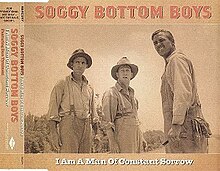
A notable encompass, titled "I Am a Man of Constant Sorrow", was produced past the fictional folk/bluegrass group The Soggy Lesser Boys from the film O Blood brother, Where Art Thou?.[2] The producer T Bone Burnett had previously suggested the Stanley Brothers' recording as a song for The Dude in the Coen brothers' motion-picture show The Big Lebowski, but it did not brand the cut. For their next collaboration, O Blood brother, Where Art Thou?, he realized that the song would adjust the main character well.[2] [37] The initial programme was for the song to be sung by the film'due south atomic number 82 actor, George Clooney; still, it was institute that his recording was not upward to the required standard.[38] Burnett later said that he had only two or three weeks to piece of work with Clooney, which was non enough time to prepare Clooney for the recording of a credible hit country record.[37]
The song was recorded past Dan Tyminski (lead vocals) , with Harley Allen and Pat Enright, based on the Stanleys' version.[15] Tyminski also wrote, played, and changed the guitar part of the arrangement.[37] Two versions by Tyminski were found in the soundtrack album, with unlike backup instruments. In the picture, it was a hit for the Soggy Lesser Boys, and would later go a existent hit off-screen. Tyminski has performed the song at the Crossroads Guitar Festival with Ron Block and live with Alison Krauss.
The song received a CMA Award for "Single of the Yr" in 2001 and a Grammy for "Best Country Collaboration with Vocals" in 2002. The vocal was too named Song of the Year by the International Bluegrass Music Clan in 2001.[39] It peaked at No. 35 on Billboard's Hot Country Songs nautical chart.[15] It has sold over a million copies in the Us by November 2016.[40]
Personnel [edit]
Source: [41]
- Banjo – Ron Block
- Bass – Barry Bales
- Dobro – Jerry Douglas
- Dabble – Stuart Duncan
- Guitar – Chris Sharp
- Harmony vocals – Harley Allen, Pat Enright
- Lead vocals, guitar – Dan Tyminski
- Mandolin – Mike Compton
- Arranged past – Carter Stanley
Charts [edit]
Others [edit]
- 1920s – American Delta blues artist Delta Blind Billy in his song "Hidden Man Blues" had the line 'Human being of sorrow all my days / Left the home where I been raised.'[44]
- 1937 – Alan Lomax recorded Sarah Ogan Gunning's performance of her version, "I Am a Girl of Constant Sorrow", for the Library of Congress's Archive of American Folk Song. Her version was also covered past other singers such every bit Peggy Seeger (her melody however is more similar to Arthur'southward version), Tossi Aaron, and Barbara Dane. She recorded the song again at the 1964 Newport Folk Festival, and also released a recording in her album, Girl of Constant Sorrow, in 1965.[xiv]
- 1947 – Lee and Juanita Moore's performance at a radio station WPAQ was recorded and later released in 1999. They were granted a new copyright registration in 1939 for their handling of the song.[2] [45]
- 1960 – A version of the song, "Daughter of Constant Sorrow", was recorded by Joan Baez in the summer of 1960.[28] This version was left off the original release of her debut album Joan Baez in 1960 on the Vanguard label, merely was included as a bonus runway on the 2001 CD-reissue version of the album.[46] [47] Baez has also recorded "Man of Constant Sorrow" with no change in gender.[48]
- 1961 – Judy Collins'southward 1961 debut album, A Maid of Constant Sorrow, took its name from a variant of the song which was included on the album.[49]
- 1961 – Roscoe Holcomb recorded a version.[iv]
- 1962 – Information technology appears on Mike Seeger'southward album Old Fourth dimension Country Music, Folkways FA 2325.[50] Mike Seeger recorded 3 versions of the song.[iv]
- 1962 – in their 1962 self-titled debut album, Peter, Paul and Mary recorded another version every bit "Sorrow".[51]
- 1966 – It was recorded past Waylon Jennings on his 1966 major-characterization debut Folk-Country.[52]
- 1969 – Rod Stewart covered the song in his debut solo album. It was based on Dylan'south version just with his own arrangement.[53]
- 1972 – An a cappella version appears on The Dillards' 1972 LP Roots and Branches.[54] This version had only two verses and replaced Kentucky with Missouri.
- 1993 – "Man of Constant Sorrow" was one of many songs recorded past Jerry Garcia, David Grisman, and Tony Rice i weekend in February 1993. Jerry's taped copy of the session was later stolen past his pizza delivery man, eventually became an underground classic, and finally edited and released in 2000 as The Pizza Tapes.[55]
- 2003 - Skeewiff "Human being of Constant Sorrow" was ranked 96 in the Triple J Hottest 100, 2003, released on Book xi disk 1 track twenty.[56]
- 2012 - Charm Urban center Devils released "Human being Of Constant Sorrow" which charted on various Billboard rock charts - No. 25 on Mainstream Rock Songs[57] No. 22 on Active Rock,[58] and No. 48 on Hot Rock Songs.[59]
- 2015 – Dwight Yoakam covered the song in his album Second Hand Heart. Yoakam's rendition has been described equally having a 'rockabilly' audio.[60] [61]
- 2015 – Blitzen Trapper covered the vocal exclusively for the blackness one-act–crime drama tv series Fargo, which played over the credits of the "Rhinoceros" episode of the second season.[62]
- 2018 – Abode Costless, covered the vocal in a country / a capella style. Information technology was released also on their album Timeless.[63]
- 2021 - In the Channel four sitcom Nosotros Are Lady Parts, the main grapheme, Amina, sings a variation of the vocal with the lyrics changed to fit her situation.[64]
Parodies [edit]
In 2002, Cledus T. Judd recorded a parody titled "Man of Constant Borrow" with Diamond Rio on his album Cledus Envy.[65]
References [edit]
- ^ "'O Blood brother' Soundtrack Rules 44th Annual Grammy Awards". BMI. February 27, 2002.
- ^ a b c d e f g h Steve Sullivan (October 4, 2013). Encyclopedia of Peachy Pop Vocal Recordings, Volume 2. Scarecrow Press. pp. 254–255. ISBN978-0810882959.
- ^ "Man of Abiding Sorrow – Richard Burnett's Story", Sometime Time Music, No. 10 (Fall 1973), p. 8.
- ^ a b c d east f m Todd Harvey (2001). The Formative Dylan: Transmission and Stylistic Influences 1961-1963. Scarecrow Press. pp. 65–67. ISBN978-0810841154.
- ^ a b c d e f grand John Garst (2002). Charles K. Wolfe; James E. Akenson (eds.). Country Music Annual 2002. Academy Printing of Kentucky. pp. 28–30. ISBN978-0-8131-0991-6.
- ^ "Isaiah 53:iii". Bible Gateway.
- ^ George Pullen Jackson (1943). Down-East Spirituals and Others. pp. lxx–71.
- ^ a b c d Steve Sullivan (Oct 4, 2013). Encyclopedia of Great Popular Song Recordings, Volume 2. Scarecrow Press. pp. 296–297. ISBN978-0810882959.
- ^ John Garst (2002). Charles K. Wolfe; James Eastward. Akenson (eds.). Country Music Annual 2002. University Press of Kentucky. pp. thirty–37. ISBN978-0-8131-0991-6.
- ^ "Dr. Ralph Stanley: "Man of Constant Sorrow: My Life and Times" autobiography due out Oct 15". www.bluegrassjournal.com. Archived from the original on Feb 19, 2012.
- ^ Stanley discusses song's origins on the Diane Rehm Show Archived 2009-10-16 at the Wayback Machine (link to audio program's web folio)
- ^ a b c d "Folk Phone: "Man of Constant Sorrow"". The Music Court. June 18, 2010.
- ^ a b c d eastward Paul Williams (Dec 15, 2009). Bob Dylan: Performance Artist 1986-1990 And Across (Listen Out Of Time) (Kindle ed.). Omnibus Press. ISBN978-0857121189.
- ^ a b c "Sarah Ogan Gunning - Daughter of Constant Sorrow". Folk Legacy.
- ^ a b c d e f Evan Schlansky (June 30, 2011). "Behind The Song: "Human Of Constant Sorrow"". American Songwriter.
- ^ a b c Oliver Trager (2004). Keys to the Rain: The Definitive Bob Dylan Encyclopedia. Billboard Books. pp. 411–412. ISBN978-0823079742.
- ^ Robert Shelton (4 April 2011). No Direction Home: The Life and Music of Bob Dylan. Omnibus Press. ISBN978-1849389112.
- ^ Robert Shelton (iv April 2011). No Direction Abode: The Life and Music of Bob Dylan. Omnibus Printing. ISBN978-1617130120.
- ^ Greil Marcus (2010). Bob Dylan by Greil Marcus: Writings 1968-2010 . PublicAffairs,U.Southward. p. 394. ISBN9781586489199.
- ^ Charles K. Wolfe (November 26, 1996). Kentucky State: Folk and Country Music of Kentucky (Reprint ed.). University Press of Kentucky. p. 36. ISBN978-0813108797.
- ^ a b David W. Johnson (24 January 2013). Lonesome Melodies: The Lives and Music of the Stanley Brothers. University Printing of Mississippi. pp. 23–24. ISBN978-1617036460.
- ^ "Sawyer Fredericks Auditions For The Phonation With "I Am A Homo Of Constant Sorrow"". The San Francisco World. March 20, 2015.
- ^ "Stanley Brothers, The & Clinch Mountain Boys, The* – The Lonesome River / I'g A Man Of Constant Sorrow". Discogs.
- ^ Gary B. Reid (December 15, 2014). The Music of the Stanley Brothers. University of Illinois Press. p. 103. ISBN978-0252080333.
- ^ David Due west. Johnson (24 January 2013). Lonesome Melodies: The Lives and Music of the Stanley Brothers. University Press of Mississippi. p. 169. ISBN978-1617036460.
- ^ "Stanley Brothers". Bluegrass discography.
- ^ Gary B. Reid (December 15, 2014). The Music of the Stanley Brothers. University of Illinois Press. p. 100. ISBN978-0252080333.
- ^ a b Tom Moon (Baronial 4, 2008). one,000 Recordings to Hear Before Yous Dice . Workman Publishing Company. p. 39. ISBN978-0761139638.
- ^ Richard Middleton (September 5, 2013). Voicing the Pop: On the Subjects of Popular Music (ebook ed.). ISBN9781136092824.
- ^ Jerry Hopkins (September 20, 1969). "'New' Bob Dylan Album Bootlegged in L.A." RollingStone.
- ^ Michael Gray (21 September 2006). The Bob Dylan Encyclopedia. Bloomsbury Academic. p. 76. ISBN978-0826469335.
- ^ John Nogowski (xv July 2008). Bob Dylan: A Descriptive, Critical Discography and Filmography, 1961-2007 (2nd Revised ed.). McFarland & Co Inc. ISBN978-0786435180.
- ^ Vince Farinaccio (2007). Nothing to Turn Off: The Films and Video of Bob Dylan. p. 246. ISBN9780615183367.
- ^ "Ginger Baker'southward Air Strength". AllMusic.
- ^ "Ginger Baker's Air Force Chart History (Hot 100)". Billboard.
- ^ "Acme RPM Singles: Issue 3828." RPM. Library and Athenaeum Canada. Retrieved 30 January 2021.
- ^ a b c T Os Bennett (August 22, 2011). "O Brother, Where Art M?". Huffington Postal service.
- ^ Ben Child (Jan 29, 2014). "Ten things we learned from George Clooney's Reddit AMA". The Guardian.
- ^ "Recipient History". IBMA. Archived from the original on 2018-01-03. Retrieved 2015-06-04 .
- ^ Bjorke, Matt (November 28, 2016). "Top xxx Digital Singles Sales Report: November 28, 2016". Roughstock.
- ^ O Brother, Where Fine art Thou? (2000), Mercury Records, 170 069-ii
- ^ "Soggy Lesser Boys Feat. Dan Tyminski – I Am A Man Of Constant Sorrow" (in French). Les classement single.
- ^ "Soggy Bottom Boys Nautical chart History (Hot Country Songs)". Billboard.
- ^ "Delta Blind Billy - Hidden human dejection". Archive.org.
- ^ "WPAQ: Phonation of the Blue Ridge Mountains". AllMusic.
- ^ Joan Baez Allmusic link
- ^ James E. Perone (October 17, 2012). The Album: A Guide to Popular Music's About Provocative, Influential, and Of import Creations. Praeger. ISBN978-0313379062.
- ^ "Joan Baez – Very Early on Joan". Discogs.
- ^ Trent Moorman (February 11, 2015). "Judy Collins Has Done Everything (Except Busking)". The Stranger.
- ^ Bill C. Malone (24 October 2011). Music from the Truthful Vine: Mike Seeger's Life and Musical Journey. The University of North Carolina Press. p. 119. ISBN978-0807835104.
- ^ Craig Rosen (xxx September 1996). The Billboard book of number one albums: the inside story behind pop music's blockbuster records. Billboard Books.
- ^ Vladimir Bogdanov; Chris Woodstra; Stephen Thomas Erlewine (November 1, 2003). All Music Guide to Country: The Definitive Guide to Country Music. Backbeat Books. p. 376. ISBN978-0879307608.
- ^ Eric five.d. Luft (October nine, 2009). Die at the Right Fourth dimension!: A Subjective Cultural History of the American Sixties. Gegensatz Press. ISBN9781933237398.
- ^ John Einarson (2001). Desperados: The Roots of Country Rock . Cooper Square Press. p. 206. ISBN978-0815410652.
- ^ Vladimir Bogdanov; Chris Woodstra; Stephen Thomas Erlewine (nineteen December 2003). All Music Guide to Country: The Definitive Guide to Country Music (2nd Revised ed.). Backbeat Books. ISBN978-0879307608.
- ^ "Hottest 100 - History - 2003". www.abc.net.au.
- ^ "Mainstream Rock songs: Baronial 4, 2012". Billboard.
- ^ "Active Rock: June 30, 2012". Billboard.
- ^ "Hot Rock Songs: June nine, 2012". Billboard.
- ^ "Review: Dwight Yoakam, '2d Hand Heart'". NPR.org.
- ^ Sterling Whitaker (February 5, 2015). "Dwight Yoakam Announces Details of 15th Studio Anthology". Taste of Country.
- ^ "Review: 'Fargo' - 'Rhino': Assault on precinct Luverne?". HitFix. November 17, 2015.
- ^ "Home Free's Roots Run Deep In "Man of Constant Sorrow" Video". The Country Note. 29 September 2018. Retrieved half dozen April 2019.
- ^ "We Are Lady Parts". Aqueduct iv . Retrieved 2021-05-24 .
- ^ Cledus Envy (CD liner notes). Cledus T. Judd. Nashville, Tennessee: Monument Records. 2008. 85897.
{{cite AV media notes}}: CS1 maint: others in cite AV media (notes) (link)
Farther reading [edit]
- John Garst (2002). ""Human of Constant Sorrow": Antecedents and Tradition". In Charles K. Wolfe; James E. Akenson (eds.). Country Music Annual 2002. University Press of Kentucky. pp. 26–53. ISBN978-0-8131-0991-vi.
External links [edit]
- "Folk Telephone: "Man of Constant Sorrow"". The Music Court. June xviii, 2010. Contains lyrics for Burnett'due south and the 1950 Stanley Brothers' versions
- "Human of Constant Sorrow". Bob Dylan'south Musical Roots. Lyrics for Bob Dylan'southward 1961 recording and Stanley Brothers' 1959 version from Newport Folk Festival
Source: https://en.wikipedia.org/wiki/Man_of_Constant_Sorrow
0 Response to "Who Sang Man of Constant Sorrow in the Movie O Brother Where Art Thou"
Post a Comment